
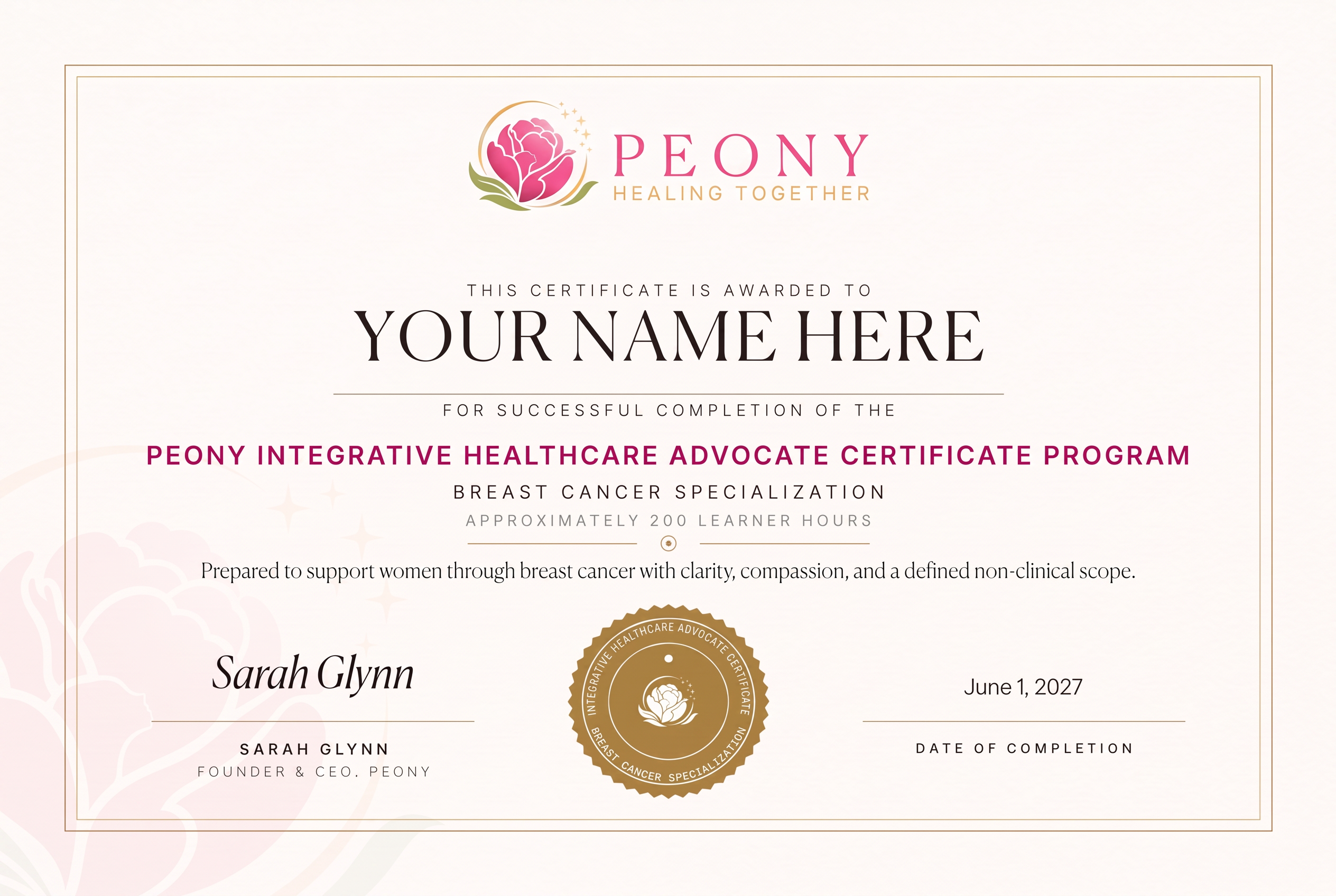
THE PEONY INTEGRATIVE HEALTHCARE ADVOCATE CERTIFICATE
Become the Breast Cancer Advocate She Can Turn To.
The Integrative Healthcare Advocate™ Certificate Program prepares you to provide informed, whole-person navigation and support through the questions, decisions, and transitions of breast cancer.
Applications open October 1 · Founding class begins March 10, 2027 · Approximately 200 learner hours
WHY THIS EXISTS
The role I needed did not exist.
During my own breast cancer treatment, I had excellent doctors, trusted practitioners, a supportive family, and twenty-five years of experience in health education.
And I was still the person trying to connect all the pieces.
I built the Integrative Healthcare Advocate™ role around the support I wished had existed for my mother, and the support I realized women still need between appointments.
WHY THIS ROLE
Cancer care has many experts. The woman is still the one carrying the whole experience.
Between appointments, breast cancer keeps happening.
There are questions to remember, decisions to prepare for, symptoms to track, specialists to coordinate, family and work to manage, supportive care to consider, and a life that still has to keep moving.
Nurses, navigators, social workers, advocates, community health workers, practitioners, and family members may each carry important parts.
The Integrative Healthcare Advocate™ is designed to help connect the whole picture.
It is a defined, non-clinical role built around whole-person care planning, navigation, self-advocacy, coordination, and support across the breast cancer journey.
Not another person telling her what to do.
Someone trained to help her understand what matters, know what questions to ask, connect the right people, and keep moving forward with greater clarity.
THE ROLE
Be the person who helps her keep the whole picture connected.
Integrative Healthcare Advocates™ use the Peony Care Plan™ to help women understand what is happening, prepare for what comes next, connect the people around them, and put their own priorities into action.
An Integrative Healthcare Advocate™ may help a woman:
- understand and organize the bigger picture of her care
- create and use her own Peony Care Plan™
- prepare for appointments, questions, and decisions
- understand general breast cancer information using approved resources
- identify supportive resources and appropriate professionals
- coordinate non-clinical follow-through between appointments
- strengthen self-advocacy and participation in care
- recognize when a question needs to go back to the medical team or another licensed professional
The role is deliberately non-clinical.
Integrative Healthcare Advocates™ do not diagnose, prescribe, interpret clinical results, determine treatment, or replace licensed professionals.
The woman owns her Care Plan. The Companion helps her understand, organize, prepare, connect, and follow through.
Licensed practitioners continue to work within their existing professional scope. The Integrative Healthcare Advocate™ role adds a separate framework for non-clinical navigation and support.
What is outside an Integrative Healthcare Advocate's scope?
- Diagnoses, or interprets tests, imaging, pathology, staging, or genomic results
- Recommends, prescribes, adjusts, or discourages treatments, medications, supplements, diets, or therapies
- Evaluates whether an intervention is appropriate or safe for an individual
- Delivers clinical or psychotherapeutic treatment
- Creates, owns, directs, or overrules the person's Care Plan
- Clinically triages or determines the medical severity of symptoms
- Represents themselves as licensed, board-certified, or authorized to bill on the basis of this certificate
IN PRACTICE
What being an Integrative Healthcare Advocate™ actually looks like.
A woman is three days from a treatment decision and still does not understand her options.
You help her organize what she knows, identify what she still needs to understand, and prepare the questions she wants to bring back to her medical team.
Another is taking several supplements recommended by people she trusts.
You help her put everything in one place so the appropriate clinician or pharmacist can review it.
A third has an appointment tomorrow and cannot remember the questions that kept her awake at 2 a.m.
You already have them written down.
This is not about becoming her doctor.
It is about helping her feel less alone, less overwhelmed, and better able to navigate what comes next.
HOW IT FITS
Designed to work alongside the people already caring for her.
Integrative Healthcare Advocates™ do not replace nurse navigators, oncology social workers, health coaches, patient advocates, community health workers, or clinical practitioners.
They add continuity across the spaces between those roles.
The Companion's job is not to become the expert in everything.
It is to help the woman keep the whole picture visible, know where each question belongs, and stay connected to the right support.
See detailed scope and role comparison
| Role | Typical primary focus | How the Companion differs |
|---|---|---|
| Nurse navigator | Clinical navigation and triage | Non-clinical; extends continuity between encounters without triage |
| Oncology social worker | Licensed psychosocial assessment and crisis intervention | Supports and refers rather than assesses or intervenes |
| Health coach | Behavior change | Whole-person navigation across the continuum, not behavior change alone |
| Patient advocate | Advocacy; sometimes billing or insurance | Structured navigation through a single method, within a defined non-clinical scope |
| Community health worker | Community-based access and navigation | Breast-cancer-specialized, across the full continuum |
WHERE THIS CAN LEAD
Bring the role into the work you want to do.
Integrative Healthcare Advocates™ may bring this training into two primary settings.
Within a healthcare or cancer-support organization
Work as part of a larger care or navigation team, with the organization determining responsibilities, supervision, documentation, and any applicable billing structure.
In your own practice
Support women directly through a private, non-clinical navigation practice, or add Integrative Healthcare Advocate services to work you already do.
Your professional scope, business structure, insurance, contracts, and regulatory requirements remain your responsibility.
Can Integrative Healthcare Advocates work within Principal Illness Navigation programs?
Some Integrative Healthcare Advocate activities may resemble elements described in CMS Principal Illness Navigation policy. Any use within a billing arrangement depends on the billing practitioner's eligibility, supervision, documentation, consent, current payer rules, state requirements, and independent legal and compliance review.
PIN alignment describes the shape of the work and the conditions under which a billing practice may engage a Companion as auxiliary personnel. It is not a credential, does not authorize billing, and does not alter scope. Under CMS rules, PIN services are furnished incident to a billing practitioner under general supervision — the navigator never bills directly. Billing determinations rest with the billing practitioner and their organization.
THE PROGRAM
Learn it. Practice it. Demonstrate that you can do it.
Approximately 200 learner hours across eight months, designed to move from foundational knowledge to real supervised practice.
Expect an average commitment of about 5–6 hours per week.
SIX MODULES
The curriculum
1 · Whole-Person Cancer Care
Understand the breast cancer journey beyond treatment alone, and where the Integrative Healthcare Advocate™ role fits.
2 · The Peony Care Method™
Learn how to help a woman create, use, and evolve her own Peony Care Plan™.
3 · Professional Practice
Build clear boundaries, ethical judgment, collaboration skills, documentation habits, and professional confidence.
4 · Breast Cancer Foundations
Understand the language of diagnosis, pathology, staging, biomarkers, and the major decisions women encounter.
5 · Breast Cancer Treatment Pathways
Learn how surgery, chemotherapy, radiation, targeted therapy, endocrine therapy, and supportive care fit into the larger journey.
6 · Navigation in Practice
Bring everything together through real-world navigation, barriers, resources, coordination, and continuity of support.
Gain the breast cancer knowledge and context to support women with more confidence, ask better questions, and connect care more effectively.
EXPERT EDUCATION
Go deeper into the issues women actually bring to you.
Twelve expert-led sessions explore the whole-person issues that often sit alongside breast cancer treatment, including:
- Evaluating complementary-therapy evidence, supplementation, and interaction risk (foundation session, taken first)
- Fatigue, sleep, and cognitive changes
- Pain, neuropathy, and musculoskeletal effects
- Lymphedema and lymphatic health
- Nutrition, appetite, digestive and metabolic health
- Movement, exercise, and rehabilitation
- Bone and cardiovascular health
- Endocrine therapy, menopause, and vaginal and pelvic floor health
- Distress, nervous system regulation, and mind-body practice
- Sexual health, intimacy, body image, and visible change
- Survivorship, recurrence risk reduction, late effects, and healthy aging
- Advanced and metastatic disease; palliative and supportive care
SUPERVISED PRACTICE
Real-world application is where the training becomes meaningful.
Each learner supports three women navigating breast cancer through a structured series of supervised Care Plan engagements.
You will practice:
- whole-person discovery
- Care Plan facilitation
- appointment and decision preparation
- identifying support and navigation needs
- follow-through over time
- documentation
- consultation, referral, and escalation
Learners work in pairs so each person both leads and observes real engagements.
Participants are matched through Peony and explicitly consent to working with supervised learners.
Completing the required engagements is not enough by itself. Learners receive the certificate only when faculty determine that they can perform the required activities safely, reliably, and within scope.
THE STANDARD
You earn the certificate by demonstrating that you are ready.
This is not an attendance certificate.
To graduate, learners must demonstrate competence across the core activities of Integrative Healthcare Advocate practice, including:
- building trusted relationships
- whole-person discovery
- Care Plan facilitation
- navigation across the breast cancer journey
- coordination and referral
- collaboration with the healthcare team
- evidence-informed education
- shared decision support
- documentation
- recognizing limits and escalating appropriately
The graduation standard is simple:
Can we trust you to perform this role safely, reliably, within scope, and to know when to ask for help?
WHO SHOULD APPLY
For people who feel called to support women through breast cancer more deeply.
You do not need to become a clinician to become deeply useful to a woman navigating breast cancer.
The program is designed for people bringing experience from health, wellness, navigation, advocacy, caregiving, or lived experience.
Healthcare & allied health
Nurses · Patient navigators · Community health workers · Social workers · Genetic counselors · Rehabilitation professionals
Integrative & wellness
Health coaches · Nutrition professionals · Exercise specialists · Mental health professionals · Integrative and complementary practitioners
Community & advocacy
Breast cancer survivors · Caregivers · Patient advocates · Nonprofit professionals · People seeking meaningful, purpose-driven work
To apply, you will need active Peony PRO membership and completion of the Peony PRO Orientation.
Applications open October 1.
FOUNDING PROGRAM
Be part of the first Integrative Healthcare Advocate™ class.
EARLY BIRD TUITION
$4,500
Save $1,500 from the standard $6,000 tuition.
Installment Plans Available
Additional required costs:
$450 · First-year Peony PRO membership
$150 · Technology fee
Total 12-month certificate program investment: $5,100
ADMISSIONS REQUIREMENTS
- Active Peony PRO membership
- Online application
- Personal statement
- Interview
- Acceptance under published admissions criteria
AFTER GRADUATION
Stay connected to the profession you are helping build.
Graduates who maintain Peony PRO membership, complete ongoing professional education, and remain in good standing may maintain Active Standing as a Peony Integrative Healthcare Advocate™.
Beginning with the launch of Peony CONNECT, verified profiles may display:
- Integrative Healthcare Advocate™ certificate status
- Breast Cancer specialization
- Advanced Apprenticeship status
- Business contact details
Ongoing education and accountability are designed to keep the role current, credible, and connected as the field develops.
QUESTIONS
Before you apply.
Do I need a clinical license?
No. The role is deliberately non-clinical, and no license is required to apply or to practice as an Integrative Healthcare Advocate™. Licensed practitioners continue to work within their existing professional scope; this is an additional, defined non-clinical role.
Who is this program best suited for?
People bringing experience from health, wellness, navigation, advocacy, caregiving, or lived experience who want to support women through breast cancer more deeply.
What will I actually be able to do after completing it?
You will be able to facilitate a woman's own Peony Care Plan™, prepare her for appointments and decisions, help her organize the whole picture, coordinate non-clinical follow-through, and know when a question belongs with a licensed professional.
How much time should I expect each week?
About 5 to 6 hours a week across eight months — approximately 200 learner hours in total. The program is designed to be completed alongside existing work.
Can I add Integrative Healthcare Advocate services to my existing practice?
Yes. Many learners add Integrative Healthcare Advocate™ services to work they already do. Your professional scope, business structure, insurance, contracts, and regulatory requirements remain your responsibility.
Can I build a private Integrative Healthcare Advocate practice?
Yes. You may support women directly through a private, non-clinical navigation practice, within the same responsibilities for scope, business structure, insurance, and regulatory requirements.
How does this differ from a health coach or patient navigator?
Integrative Healthcare Advocates™ do not replace nurse navigators, oncology social workers, health coaches, patient advocates, community health workers, or clinical practitioners. The role adds continuity across the spaces between those roles, using a shared method and a defined non-clinical scope.
Do I need to be a Peony PRO member?
Yes, to apply. Membership and applications both open October 1. Join, complete Orientation, and apply.
What happens if I need more supervised practice before graduating?
The certificate is awarded on demonstrated competence, not on hours completed. A learner who finishes the engagements without meeting the standard continues in supervised practice until the evidence is there.
What does the certificate qualify me to do?
This is an educational certificate in non-clinical breast cancer navigation and support. It does not confer professional licensure, independent personnel certification, or authorization to bill insurers. Your underlying professional scope, business arrangements, insurance, and regulatory responsibilities remain your own.
FOUNDING CLASS
Help define what this role can become.
The first Integrative Healthcare Advocate™ class will help set the standard for the role.
You will be the first group to move through the complete curriculum, supervised practice, and competency process — and your experience will help Peony strengthen the program for the people who follow.
FOUNDING CLASS DETAILS
- Applications
- Open October 1
- Class begins
- March 10, 2027
- Theoretical Studies Complete, Capstone Begins
- September 7, 2027
- First certificates conferred
- December 2027
- Advanced Apprenticeship Opens (Optional)
- January 2028
If you feel called to help women navigate breast cancer with more clarity, continuity, and support, this is where that work begins.
Ready to walk beside her?
Applications for the founding Integrative Healthcare Advocate™ class open October 1.
$4,500 Early Bird Tuition
Early Bird pricing ends December 31 · Program begins March 10, 2027
Already exploring Peony PRO?
Explore Peony PRO Membership →